Hello and happy February to one and all! I hope this finds you well. Since our last blog post we have been busy with finalising all the business details, and, more excitingly, starting work on some projects! This explains why the blog has sadly been a bit neglected, but a springtime resolution of more regular posts is now in force so expect more regular updates.
Today I was reading the Guardian and saw that the shortlist for the annual Chartered Institution of Water and Environmental Management (CIWEM) environmental photographer of the year has been released. As I enjoy photographic exhibitions and competitions, I found myself flicking through the entries. The photograph that caught my eye is by Steve Brockett, and is of an empty housing estate in Spain.
Looking at the image, two things strike me. Firstly, it points to the problems the global recession has caused for the housing market. These are model houses, built in Spain before the bottom fell out of the market. They all lie empty, awaiting new owners who will, at best, take years to move in and meanwhile those who already took ownership live in eerily quiet, soulless expanses of estate.
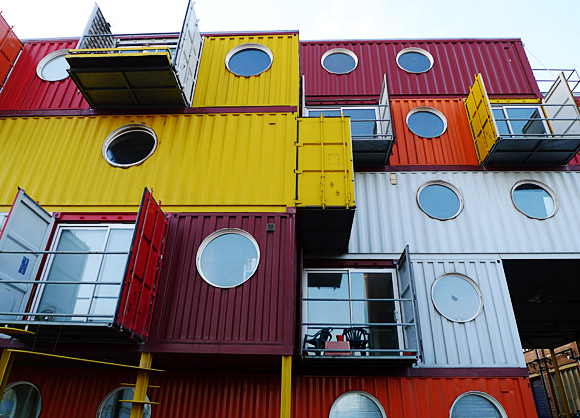
However, I am more struck by how unsuccessful the overall visual effect of the estate is. There is a photographic trick where if you squint at a scene, if there is not enough contrast in the scene, there is unlikely to be in the final image. This is because we are naturally drawn to images and landscapes with enough variety to stimulate us. For me, when I quint at this scene, the houses blur into one. (Note, this is nothing to do with the image itself, which I very much admire, more the architecture of the houses)
Instead of unifying the area into a cohesive estate with a distinctive sense of personality and identity, and achieving the right balance of coherence, complexity, mystery and legibility (Kaplan and Kaplan, 1989), the different colours and designs do not hang well together, creating a visual landscape that cannot easily be read and, for me, just doesn’t work.
We need to strike a careful balance in our building between schemes that are too uninteresting and do not provide enough visual stimulus and those that are overly complicated and jarr for being too varied.
But why is it important to get this balance right? In my opinion, the outside of your house is as important as the inside. On the inside, generally speaking, you have control over what it looks and feels like, and you are able to put your stamp on it. But on the outside, there is quite often much less control on behalf of the tenant or occupier, and therefore much less opportunity to use the exterior design as an expression of your identity. If we are trying to solve the housing crisis, not only do we need to be building more homes, but we also need to be building the houses that people want to live in.
Having said all of this, I'd like to acknowledge that in the article we wrote for the OAA, I argued that judgements of an aesthetic nature are subjective. The opinion above is my own, and I bring my own views of beauty and design to critiques. Some of you might be thinking this estate is wonderful, and that we need more places like it. I'd love to hear those arguments as well as any comments in favour of the design. After all, the more discussion and debate we have, the better places we will build.
Have a good week,
Sarah @ Space Works.